Hybrid working has transformed the company canteen. Staff no longer arrive at the office at the same time every day and expect greater flexibility during their working day. As a result, corporate catering is evolving from a traditional lunch service into a flexible food hub where hospitality, convenience and socialising come together.
But how do you adapt to this without complicating day-to-day operations? And how do you ensure that an attractive catering concept remains practical, affordable and feasible? In this article, you’ll find out what hybrid working means for corporate catering and how to turn the staff canteen into a food hub that suits today’s workplace.
Hybrid working is changing the way offices are used
For many organisations, hybrid working has become an integral part of the working week. Staff divide their time between the office, home and other work locations. As a result, office occupancy can vary significantly from day to day and even from moment to moment. The reason for coming into the office is also changing. Individual work can often be carried out at home. In the office, however, staff seek collaboration, consultation and personal contact. The workplace is therefore increasingly becoming a place for meeting and connecting. This development has direct implications for corporate catering. Whereas caterers could previously rely on reasonably predictable visitor flows and a fixed lunch time, they must now be able to adapt to fluctuating numbers, varying work patterns and new times for eating and drinking.
The staff canteen is no longer just a place to have lunch. It is increasingly becoming a central hub where eating, drinking, socialising and collaboration come together.
Lunch remains important, but is no longer an end in itself
The traditional lunch between twelve and one is not disappearing, but it is no longer the only important meal and drink time of the day. Employees combine appointments, workshops and meetings and are increasingly deciding for themselves where and when to eat or drink. Think of a coffee before a meeting, breakfast before an early appointment or a packed lunch taken to a project room. A snack later in the day or taking something with you for the journey is also becoming increasingly common. That is why there is a growing need for flexible catering solutions, such as:
- Grab & go concepts for staff who are short of time;
- Takeaway solutions for meetings and flexible workspaces;
- Coffee and drinks stations at various locations throughout the building;
- Breakfast, snack and lunch options throughout the day;
- Presentation and serving solutions that can adapt to staff levels;
- Packaging that combines convenience, appeal and sustainability.
In this way, catering supports not just lunchtime, but the entire working day.
From company canteen to central food hub
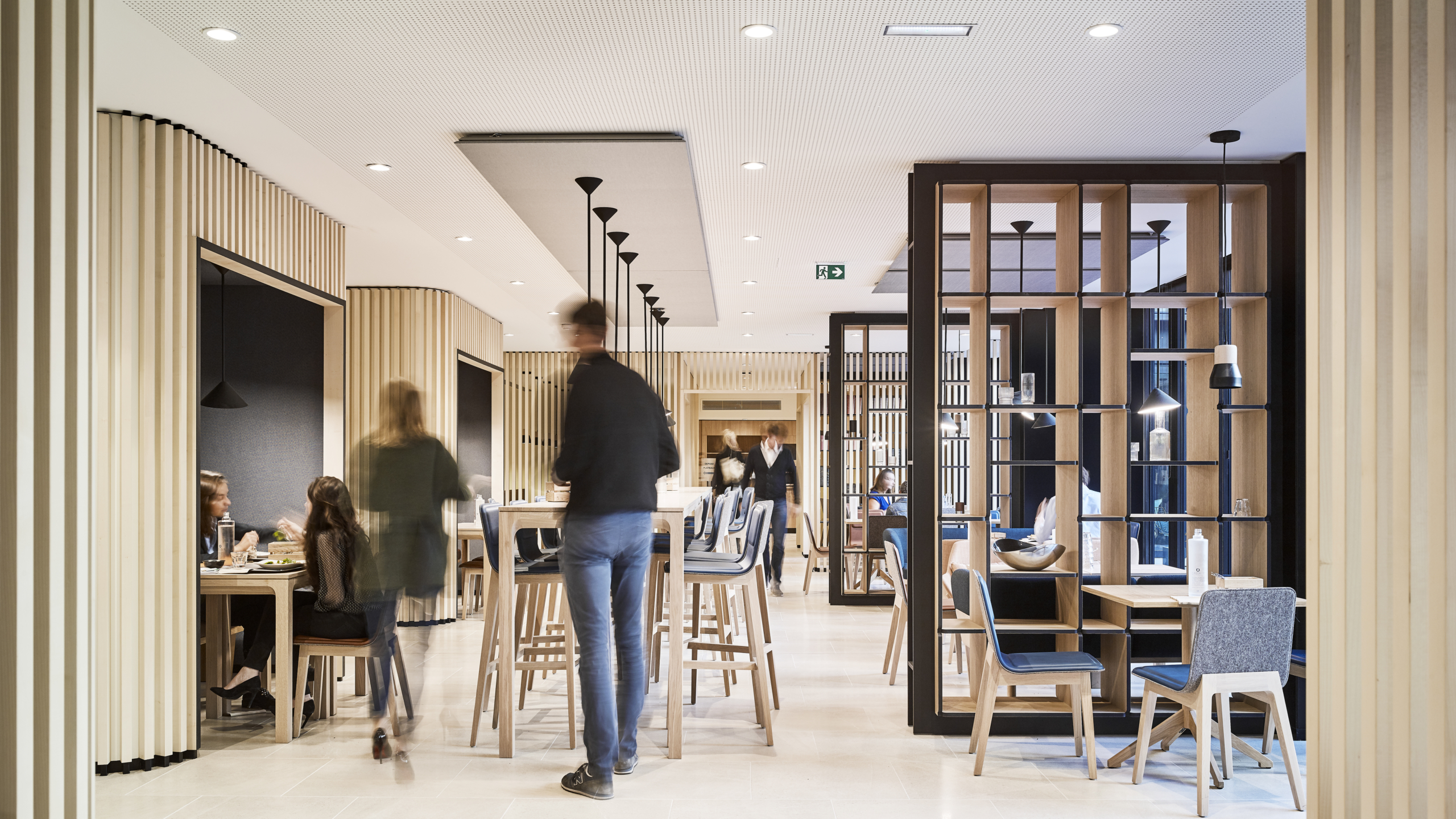
Due to these changing needs, the staff canteen is increasingly evolving into a central food hub. This is more than just a new name for the same space. A food hub supports various uses and functions within the working environment. Staff can eat and drink there, but also meet colleagues, hold informal discussions, work temporarily or simply relax for a while. This makes the food hub a visible part of the overall workplace experience. A well-designed concept brings together various needs:
- Convenience: staff can quickly choose, take away or consume something.
- Interaction: the environment encourages informal contact between colleagues.
- Flexibility: the range is tailored to fluctuating times and visitor numbers.
- Hospitality: staff and visitors feel welcome.
- Efficiency: the concept remains workable during both quiet and busy periods.
- Visual identity: the presentation is consistent with the organisation’s identity.
Consequently, the key question is no longer simply: how do we organise our lunch arrangements? Increasingly, the focus is on how food, drink and hospitality can contribute to an attractive and well-functioning workplace.
Hospitality contributes to an attractive workplace
Employers are investing in office environments that employees enjoy coming to. The focus is often on workstations, meeting rooms, interior design and technology. However, food, drink and hospitality also influence how employees and visitors experience a location. The staff canteen, in particular, is a place where people from different teams meet one another naturally. A well-presented lunch, a pleasant coffee area or an accessible ‘grab & go’ zone can therefore contribute to the atmosphere of the entire venue. A good catering conceptis thus more than just a facility. It fosters interaction, connection and job satisfaction. For visitors and job applicants, it is also a visible part of the first impression an organisation makes.
Takeaway is all about freedom and convenience
The growth of takeaway options within corporate catering is more than just a practical development. It shows that employees want more freedom to organise their working day themselves. One employee might eat in the canteen, whilst another takes a packed lunch to a meeting or grabs something later in the day. With a good takeaway concept, catering can be available at all these times, without compromising on convenience or hospitality. The right packaging plays a key role in this. It must suit the product and be user-friendly. In addition, appearance, food safety, choice of materials and the method of collection or disposal are important. Takeaway therefore requires more than just a cup, container or lid. The packaging is part of the overall catering concept and the user’s experience.
Greater flexibility for staff can create additional complexity behind the scenes. More mealtimes, different serving points and fluctuating visitor numbers can lead to increased stock levels, more tasks and more logistical movements. That is why it is important to look not only at the visible concept, but also at its day-to-day implementation. Which products are actually necessary? Can different mealtimes be supported using the same basic solutions? And how do you prevent staff from wasting time on an unnecessarily large number of items, suppliers or orders? A well-thought-out product range and smart standardisation can contribute to:
- less time spent searching and ordering;
- fewer different products in stock;
- a consistent presentation and image;
- simpler work processes;
- greater control over consumption and costs;
- reduced risk of stock-outs during peak times.
This is particularly important in a market where staff are in short supply. Catering staff need to be able to devote their time to the venue and the people using it, rather than to unnecessarily complex processes. A successful food hub concept therefore does not offer the widest range of options, but combines the right options with a workable operation.
Sustainable choices must also be practical
Sustainability goals play a key role in the development of a food hub. Organisations aim to reduce waste, make more conscious choices regarding materials and comply with changing legislation and regulations. At the same time, every solution must remain functional in day-to-day practice. A reusable solution, for example, is particularly suitable when products are reused frequently enough and collection, return logistics and cleaning are well organised. In other situations, a recyclable solution or one made from different materials may be better suited to the specific use case and the waste streams involved.
The right choice depends, amongst other things, on:
- the location and the time of use;
- consumption on the premises or on the go;
- the available collection and waste streams;
- options for cleaning and reverse logistics;
- the desired look and user experience;
- applicable laws and regulations;
- the organisation’s sustainability objectives.
At Bunzl Foodservice, we therefore look beyond just the product or material. We also take into account the application, usage and supply chain. In this way, sustainability becomes not just a separate initiative, but a practical part of the catering concept. It is not only employers and caterers who stand to benefit from an attractive catering concept. Property owners and facilities managers are also paying increasingly close attention to the facilities within a building. Office locations are no longer assessed solely on the basis of floor space, accessibility and rent. Users also look at comfort, atmosphere and the opportunities to meet other people. A well-designed food hub can contribute to a location’s appeal. It is not about having as many facilities as possible, but about a well-chosen concept that suits the users, the surroundings and day-to-day practice.
What can Bunzl Foodservice do for you?
The transition from a traditional staff canteen to a flexible food hub requires more than just a collection of individual products. Product range, presentation, sustainability, logistics, hygiene and ease of use must all work in harmony. Bunzl Foodservice helps organisations translate these considerations into practical non-food solutions. We do not start with a standard product range, but with the location, the users and the operational challenge. We can provide support with, amongst other things:
- food packaging and takeaway solutions;
- crockery, glassware and cutlery;
- presentation and serving solutions;
- coffee and beverage supplies;
- reusable and recyclable alternatives;
- hygiene and cleaning solutions;
- advice on material choices, applications and legislation;
- product range optimisation and logistics support.
But our role doesn’t stop at delivering the order. We work with you to identify how products and processes can be better aligned. By bringing together relevant non-food categories, we help organisations reduce the number of steps and suppliers involved and create a clearer overview. In this way, we support reliable behind-the-scenes operations and a welcoming experience at the front of house. This leaves catering teams with more time to devote to staff, visitors and guests.
The food hub of tomorrow starts with the user
The company canteen isn’t going away. On the contrary, its role is becoming broader. It is becoming a place where eating, drinking, socialising, collaborating and hospitality come together. A suitable food hub concept therefore doesn’t start with products or floor space, but with the user. When do staff come into the office? What opportunities for eating and drinking arise during the day? What do they need? And how can catering make their working day easier and more enjoyable?
Next comes the practical application. Which solutions offer freedom of choice and convenience, whilst remaining feasible for the catering team? Which products can be used for multiple purposes? And how do sustainability, costs and aesthetics all fit together? That is where the strength of a modern food hub lies: a welcoming and flexible experience for the user, supported by a smart and reliable operation behind the scenes.
Frequently asked questions
1. How is hybrid working changing the company canteen?
Hybrid working leads to fluctuating visitor numbers and more opportunities for eating and drinking spread throughout the working day. As a result, there is a growing need for a flexible catering concept that can easily adapt to both busy and quiet days.
2. What is a food hub within an office environment?
A food hub is a central location where food, drink, socialising and convenience come together. Staff can not only have lunch there, but also grab a coffee, take something to a meeting or make use of what’s on offer at any other time of the day.
3. Why is takeaway becoming more important in corporate catering?
Employees are increasingly keen to decide for themselves where and when they eat. Takeaway makes it possible to take food and drink to a workspace, meeting room or other location within the building.
4. How do you deal with fluctuating visitor numbers?
Opt for a well-organised and flexible range of products that can be used for a variety of dishes and mealtimes. This makes it easier to adapt to busy and quiet days without holding unnecessary stock.
5. How can corporate catering help reduce the workload?
A logical layout, user-friendly products and solutions suitable for multiple applications help to minimise the number of tasks. This leaves more time for hospitality and personal attention.
6. How can you prevent greater flexibility from leading to excess stock?
By selecting products, packaging and presentation solutions that can be used at different times and for various applications, the number of items remains manageable and stock management is simplified.
7. What should you look out for when choosing takeaway packaging?
Consider the type of dish, sturdiness, ease of use, storage, appearance and waste disposal. The right packaging supports both the user and day-to-day operations.
8. How does Bunzl Foodservice support a flexible catering concept?
Bunzl Foodservice works closely with clients to develop solutions for product ranges, takeaway services, presentation, hygiene, sustainability and operational processes. This results in a solution that is welcoming for staff whilst remaining practical and workable for catering teams.
Curious to find out how you can offer greater flexibility without adding to your workload or creating unnecessary complexity? Contact Bunzl Foodservice and discover which solutions are best suited to your venue.